
 Italiano
 Español
 Português
 Français
Comboni Missionaries, heirs to Comboni’s passion
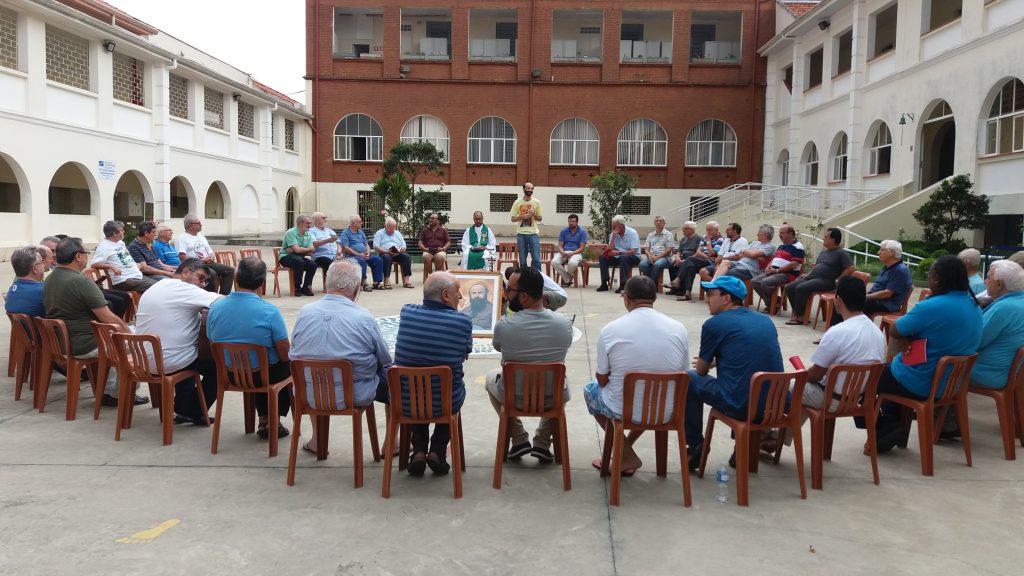
Not without a touch of pride, which translates into a deep sense of responsibility, we, the Comboni Missionaries of the Heart of Jesus (MCCJ), priests and brothers, consider ourselves “sons”, “heirs” and “followers” of St. Daniel Comboni, ‘anointed’ by that “revelation from above” which, on 15 September 1864, was given to our founder, and which Comboni explained in a text, the Plan for the Regeneration of Africa, conceived in contemplation of the mystery of the Heart of Christ the Good Shepherd.
It was a plan that sought to involve the whole Church in a dynamic of communion in favour of Africa, proposing to make African people “missionaries to their own people”.
From Comboni we have received total dedication to the missionary cause, for which he spoke, worked, lived and died. Today, like him, we want to be ready to take initiatives, to be constant in our activities, persevering, patient and strong in enduring all kinds of difficulties.
We call all this ‘charism’, that is, the gift of the Spirit of Jesus, which is expressed in the ability to share active and messianic compassion for the liberation and fullness of life of marginalised people. It takes the form of the gift of knowing how to bear witness to the ‘crucified God’, who lives at the centre of the world’s pain and reveals himself as gratuitousness towards those who suffer.
Comboni believed that “the time of grace designated by Providence to call these peoples [Africans] to take refuge in the peaceful shadows of Christ’s fold” had come, and he wanted the Church of his time to be swept by a missionary wind of involvement for “the poorest and most abandoned”.
Today, in addition to continuing to be involved in the mission as ‘first evangelisation’, we, as his heirs, intend to involve the local African Churches in living the same compassion of God for the least ones and his dream of a world as a celebration of fraternity. We want the young African Churches we have founded to be – from their very inception – ‘Churches-in-mission’, ready to ‘go out’ beyond their continent.
If Comboni identified in the African people of his time the ‘least and excluded’ whom God ‘rehabilitated’ as protagonists of his own regeneration and subjects of his own history, we, Comboni Missionaries of today, are aware that the “least and excluded” populate the streets of the whole world (given the “globalisation of poverty”), recognising that the African world, for the most part, continues to find itself in a subhuman situation.
Present in Europe and North America, we Comboni Missionaries live our charism by committing ourselves to the ‘new African diaspora’ and the interdependence of the globalised world, convinced that an ‘African mission’ must also be carried out in the post-Christian North, where many of the evils afflicting Africa and the southern hemisphere have their roots.
In his Plan, Comboni sought to involve all the agents of evangelisation already present in Africa and other available forces, recruiting missionaries of different nationalities, so that his work would be ‘Catholic – that is, universal – not Spanish or French or German or Italian’.
Thus, through missionary (animation) consciousness and vocational promotion initiatives, we aim to be instruments of unity among the many agents of evangelisation, and we spare no effort to increase the missionary awareness and commitment of the whole Church, disturbing it if necessary.
Even among civil society, following Comboni’s example, we urge realities to collaborate in the promotion of peoples.
In a world that is becoming increasingly “pluralistic”, but often constructed and managed “without the other” – if not “against the other” – we believe that the traditional “going beyond one’s own boundaries” – an integral part of Comboni’s original “charism” – must be reinterpreted in a new way.
Inspired by the teachings of Pope Francis, we believe it is necessary to move from geographical to anthropological boundaries, with a “going out of oneself”, to go towards other people who, in their differences, with their personal histories, cultures and religious experiences, become subjects of the mission and interlocutors in the discourse of evangelisation.
Faced with too many “new boundaries” – characterised by walls and structures of exclusion – we feel an imperative of our charism to “inhabit” these new boundaries and live them, inserting ourselves into their very fabric with a willingness to encounter and communicate daily, in order to transform them from barriers of closure and separation into spaces of a new imagination of the world and laboratories of a new humanity with many faces, thus renewing the practice of Jesus who sat at table with all people, giving preference to those with whom no one wanted to eat.